
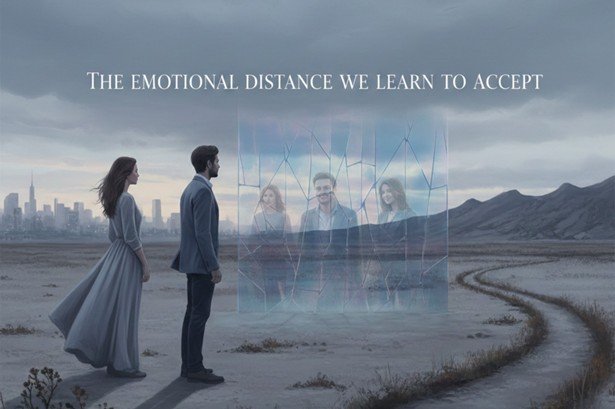
In life, we tend to be close to people, be it family, friends, colleagues, or even relationships. People want to be linked with individuals, to be known, and to know others as well. But the reality is different, as emotional closeness is not possible with everyone. And slowly, we came to know that sometimes we have to accept emotional distance also.
This distance is not always dramatic, nor is it a signal of any big problem. It sometimes grows gradually, when we understand that a person cannot be everywhere, cannot share everything, cannot experience or express every feeling completely.
In our childhood, we expected that our close ones would always stay with us. Close friends or siblings will always be available for us and support us. As we grow, we notice that the reality is really different as time passes.
Siblings have their own lives to attend to, and friends already have their own life problems. Sometimes we want them to fully understand our emotions, but the emotional bandwidth of every person is different.
And, during this whole process, we gradually develop one of the important skill i.e to tolerate the emotional distance. That means we realize that it is not necessary to have closeness and understanding every time.
The concept of schools and colleges also makes this concept more relatable…
Like in exams, when we don’t get support from our friend circles or family also not give proper attention due to some personal struggles. At that time, the first reaction is disappointment. We start feeling bad or asking questions about ourselves or others.
Questions like “I should have realized I wouldn’t get any support from anyone” or “ the other is ignoring my issues or not”. It feels bad.
But slowly we understand and prepare ourselves according to the situation that every person operates with certain limitations. Then we learn to accept emotional distance and how to deal with it. It’s a part of human nature that most people experience.
For most of the people, this acceptance does not come naturally. In the starting stage, we feel guilty, some start blaming themselves, like “Maybe I am expecting more” or “I should have avoided being too emotional”. But this guilt or overthinking is normal. But there comes a time when we realize that we can not avoid emotional distance. A person can’t be available every time. And sometimes, it’s not naturally possible to maintain the emotional closeness–that can be due to situation, personality, or timing.
This happens at the workplace also; you work in the office with different people. But you are not emotionally connected with every person. Some are supportive, and some maintain professional boundaries. At the start, you think they do not understand, or you feel alone. But slowly, we adjust to that environment.
While doing the adjustment, we came to know the reality that every person is busy in their own life; no one has that much time for you. You have to manage yourself in every situation. Every person has a different capacity for dealing with different situations. Maintaining the emotional distance and being functional and stable after that is also a natural skill of life. And that is important too, so that you can make a proper decision according to you without depending too much on any person.
The same happens in the family, also. But in the case of family, maintaining emotional distance is more confusing, as we have high expectation from our family members.
Sometimes parents do not understand our situation. Sometimes siblings seem to be uninterested in talks or gossip. Then we think, “even my people do not understand me.”
But just like in previous situations, every generation or every person handles emotions differently. Parents are unable to express, and siblings are busy with their own world and life situations. But it doesn’t mean they don’t care about you; it’s only because of limited expression and availability.
And after reaching a certain point, we stop fighting, we accept that whatever we get is what we’ll get.
These transitions are common in a friend circle, where long chit chats are turned into short texts. Friends don’t meet with each other. First, you make efforts, make decisions, and try to explain.
Then you stop.
Not because you don’t care, but you get tired. It’s not possible to keep every relationship tightly closed. And when the other side is not putting in the same effort, emotional distance automatically develops. You slowly start to move on. And we accept it, even if it is not from the heart.
In romantic relationships, emotional distance is also more noticeable. There’s a phase when talks are natural, easy to understand each other’s things. After that, our hectic schedule begins with responsibilities, stress, etc., which ultimately leads to less communication and fluctuation of emotional availability.
You notice, but first you doubt yourself.
“Maybe I’m feeling more.” or “Maybe my expectations are unrealistic.”
But after a while, a simple truth dawns on you—No one is emotionally available at the same level at every stage. And when you repeatedly demand clarity, reassurance, or connection, The relationship begins to feel heavier rather than lighter.
So people learn to compromise, not consciously, but practically. Share a little less.
React a little less.
Tolerate a little more.
But emotional distance doesn’t just exist in relationships. The most unnoticed distance is with ourselves. We become so functional that we don’t focus on feeling.
Instead of processing feelings, we normalize them. And this becomes self-directed emotional distance. We accept this distance because stopping doesn’t seem practical. Life has to go on. Not everyone can take a pause.
To avoid disappointment, we create emotional boundaries.
Expecting less feels safer. Expressing less feels easier.
Gradually, people become guarded—not because they don’t feel, but because feeling it all the time becomes exhausting. And this isn’t proof of emotional growth. It’s simply a way of survival.
Being able to accept does not imply that everything is okay. It merely translates into giving up resistance to reality.
You understand that:
Some people can’t connect as deeply.
Some relationships don’t offer as much depth. And not every stage is ready for intimacy.
This realization is heavy, but it also makes life a little more manageable.
Conclusion
Emotional distance isn’t a concept. It’s the result of daily decisions. We accept it because it’s impossible to fix everything. Some things are simply observed, not solved.
And this is what maturity is—not demanding closeness everywhere, and learning to live with whatever you have. It is a life, and we need to handle it anyway.
Additional details:
Name: Nizu SachdevaLinkedIn Profile: https://www.linkedin.com/in/nizu-sachdeva-689110152/